
Automatic Driveway Gate Cost: 2026 Northwest Arkansas Buying Guide
Erin Poe • June 4, 2026


Most homeowners view a gate as a simple weekend upgrade, but a professional entry system is actually a complex ecosystem of hardware, electronics, and local engineering. You've likely seen a massive range of figures while researching the automatic driveway gate cost online, only to find those national averages rarely account for the specific terrain or the seasonal shifts we experience here in Northwest Arkansas. It's frustrating to plan a project when the hidden requirements like electrical trenching and local permitting remain unclear.


This guide provides the clarity you need by detailing exactly what influences the price of automated systems in our region, from the durability of ornamental iron to the essential infrastructure that keeps your property secure. You'll learn how to balance aesthetic goals with functional needs like fire department access codes in Fayetteville or driveway width limits in Bentonville. We'll break down the specific components required for a reliable installation and show you how to build a system that increases your property value without the headache of constant repairs.


Key Takeaways


  • Identify the three core pillars-the gate material, the mechanical operator, and the professional installation-that determine your overall investment.


  • Understand how Northwest Arkansas terrain, specifically limestone and electrical trenching requirements, impacts the total automatic driveway gate cost.


  • Learn how to navigate specific local regulations in Bentonville and Fayetteville to ensure your gate meets fire safety and right-of-way standards.


  • Discover how modern access control technology, like smartphone-integrated intercoms, provides both convenience and a higher return on property value.


  • Compare the durability of professional-grade ornamental iron and wood systems against retail kits to ensure long-term performance in Arkansas humidity.


Table of Contents


  • What Makes Up the Total Automatic Driveway Gate Cost?


  • Cost Comparison by Gate Type and Material


  • The "Hidden" Costs: Infrastructure and Site Prep in NWA


  • Access Control and Security Tech Upgrades


  • Maximizing ROI: Maintenance and Professional Installation


What Makes Up the Total Automatic Driveway Gate Cost?


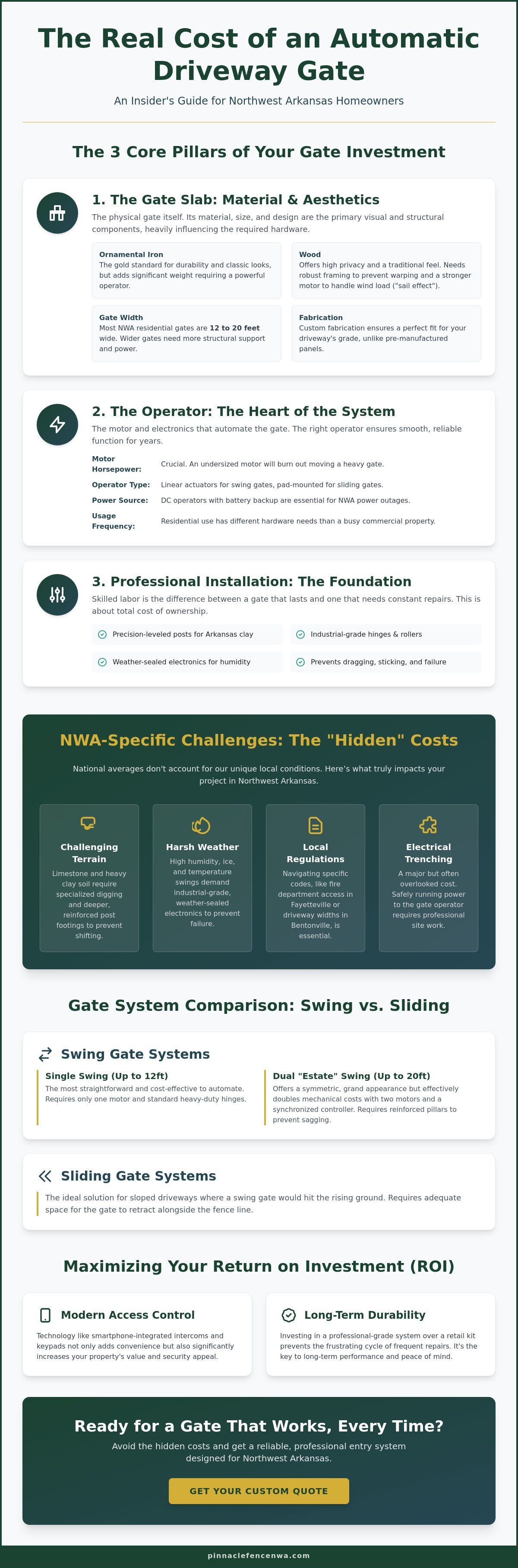
Understanding the automatic driveway gate cost requires looking past the initial sticker price. A functional system is a synergy of three distinct pillars: the gate slab, the mechanical operator, and the professional installation labor. While retail kits might seem attractive at first, they often fail to account for the heavy duty requirements of Northwest Arkansas weather. Our high humidity levels and temperature swings can quickly degrade inferior components, leading to higher maintenance costs over time. A professional-grade system is built to handle these environmental stressors while providing reliable security for decades.


The Gate Slab: Materials and Aesthetics


The slab is the physical barrier of your entry system. Material choice directly influences both the aesthetic appeal and the mechanical requirements of the project. Ornamental iron remains a popular choice for its durability and classic look, though it adds significant weight to the system. Wood fencing offers a traditional look and high privacy, but it requires robust framing to prevent sagging or warping in the Arkansas rain. Most residential gates in our area range from 12 to 20 feet in width. A wider gate requires more structural reinforcement and a more powerful motor to handle the increased leverage and wind load. Custom fabrication allows for a precise fit to your driveway's unique grade, whereas pre-manufactured panels often require expensive site modifications to function correctly.


The Operator: The Heart of the System


The operator is the engine that drives the gate.  Electric gate technology has evolved to offer several mechanical solutions based on your gate's design. Linear actuators are common for swing gates, while pad-mounted operators are the standard for sliding systems. Motor horsepower is a critical factor. An undersized motor will burn out prematurely if it's forced to move a heavy ornamental iron slab daily. You should also consider your power source. Standard AC power is reliable, but DC operators with battery backups ensure your property remains accessible during the occasional NWA power outage. The frequency of use also dictates the motor grade. A gate that opens twice a day for a private home requires different hardware than a gate serving a busy commercial complex.


Professional installation ensures that every component works in harmony. A gate that is even slightly out of level puts immense strain on the motor, shortening its lifespan. When calculating the automatic driveway gate cost, consider the Total Cost of Ownership (TCO). A professional-grade system involves several specific advantages:


  • Precision-leveled posts that resist shifting in Arkansas clay.


  • Industrial-grade hinges and rollers designed for thousands of cycles.


  • Weather-sealed electronics that withstand regional humidity and ice.


  • Structural integrity that prevents the gate from dragging or sticking.


Investing in quality hardware and skilled labor upfront prevents the cycle of frequent repairs and premature system failure. A well-installed system doesn't just provide security; it offers the peace of mind that comes from a gate that works every time you arrive home.


Cost Comparison by Gate Type and Material


The physical gate structure represents a major portion of the automatic driveway gate cost. Choosing between swing and sliding designs often depends on your driveway's slope and the available clearance. Ornamental iron is the gold standard for Northwest Arkansas properties. It offers a balance of security and longevity that other materials struggle to match. While wood and vinyl provide excellent privacy, they create a "sail effect" during high winds. This physical resistance requires more robust automation hardware to prevent motor strain during a typical Arkansas storm. Standard pre-manufactured panels are cost-effective, but custom designs allow for specific architectural flourishes that increase property value.


Swing Gate Systems: Single vs. Dual


Single swing gates up to 12 feet are the most straightforward to automate. They require only one motor and standard heavy-duty hinges. If you prefer the symmetric look of a dual "estate" gate spanning 20 feet, the mechanical cost effectively doubles. Each side needs its own motor and a synchronized control board to manage the movement. These larger systems also require reinforced pillars or heavy-gauge steel posts. This ensures the gate leaves remain level and do not sag over time, which would otherwise cause the automation to bind and fail.


Sliding Gate Systems: When to Spend More


Sliding gates are the ideal solution for sloped driveways where a swing gate would hit the rising ground. A standard V-track system requires a level concrete foundation for the track to rest on. This adds to the initial site preparation expenses. For gravel driveways or areas prone to snowy NWA winters, cantilever systems are the premium choice. These gates "hover" over the driveway without the need for a ground track. They don't get stuck on debris, ice, or gravel. While the hardware for a cantilever gate is more expensive, it offers superior reliability in varied weather conditions. You must also account for the "tail" of the gate, which requires extra side room along your fence line.


Material choice also dictates the long-term automatic driveway gate cost regarding maintenance. Ornamental iron is often powder-coated to resist the humidity that can cause rust. Wood gates require periodic staining to prevent the weight of the gate from changing as it absorbs moisture. If you are unsure which style suits your land, consulting with a local gate specialist can help you avoid costly design mistakes. Balancing the initial investment with the expected lifespan of the material ensures you get the best return on your property improvement.


The "Hidden" Costs: Infrastructure and Site Prep in NWA


The visible components of your entry system are only half of the equation. Infrastructure and site preparation often represent the most variable portion of the automatic driveway gate cost. In Northwest Arkansas, our unique geography plays a significant role in these expenses. Unlike regions with sandy or loamy soil, the Ozark foothills are characterized by dense clay and subsurface limestone. These conditions require specialized equipment and more labor hours than a standard installation. Skipping proper groundwork leads to shifting posts and misaligned sensors, which eventually forces expensive repairs.

Local regulations also impact your budget. Cities like Bentonville require a Right-of-Way permit for any work performed within the public right-of-way. In Fayetteville, specific fire department access codes dictate gate width and emergency entry requirements. Failing to account for these legal standards can lead to fines or the need to reinstall components. It's vital to check your specific HOA bylaws in Rogers or Springdale as well, as they often have strict rules regarding material finishes and setback distances from the road.


Electrical and Power Supply Requirements


Your gate needs a reliable heart to pump power to the motors and accessories. Most professional systems require a dedicated 110V circuit run from your home's electrical panel to the gate location. This ensures the system doesn't trip under the load of the motor or interference from other appliances. Low-voltage systems are an alternative for shorter runs, but they often lack the torque needed for heavy ornamental iron gates. A dedicated circuit is the best way to guarantee long-term reliability. It also provides a cleaner path for surge protection, which is essential during Arkansas spring thunderstorms.


Trenching and Groundwork


Trenching is where many homeowners encounter unexpected costs. The rocky terrain in Northwest Arkansas can double the labor time compared to softer soils. If your installer hits a shelf of limestone, they may need to use a rock saw or jackhammer rather than a standard trencher. You should also consider the path of the wire. If the electrical line must cross an existing asphalt or paver driveway, the cost of cutting and repairing that surface must be included in your estimate.


Foundation depth is equally critical. Our regional freeze-thaw cycles cause the ground to expand and contract. To prevent "frost heave" from tilting your gate posts, concrete footings must be poured deep enough to reach below the frost line. This stability ensures your gate remains perfectly aligned year-round. While deep footings and rock trenching increase the initial automatic driveway gate cost, they protect your investment from the structural failures that plague DIY or cut-rate installations.


Access Control and Security Tech Upgrades


The technology you choose serves as the brain of your entry system. While the gate slab and motor provide the physical security, the access control system determines how you and your guests interact with your property. This layer of the automatic driveway gate cost depends on whether you prefer a simple numeric keypad or a fully integrated smart home solution. High-quality tech upgrades don't just add convenience. They provide the peace of mind that comes from knowing exactly who is entering your property at any given time.


Vehicle detection loops are a critical technical investment for any automated system. These sensors are buried beneath the driveway surface to detect the presence of a car. Exit loops allow the gate to open automatically as you leave, while safety loops prevent the gate from closing on a vehicle that is still in the path of travel. Solar power is another common consideration for Northwest Arkansas homeowners. While solar can save on trenching costs for remote entrances, our region's frequent cloud cover and heavy ornamental iron gates often require larger battery banks to ensure the system remains operational during the winter months.


Smart Integration and Remote Access


Modern entry systems now offer seamless connection to Wi-Fi or cellular networks. This allows you to manage your gate from a smartphone app regardless of your location. You can grant temporary access codes to service workers or delivery drivers and receive real-time notifications when the gate is activated. For many Bentonville residents, integrating the gate with an existing home security system is a priority. This allows your cameras and alarms to work in tandem with your entrance, creating a unified security perimeter. Cloud-based management is particularly beneficial for commercial properties, where tracking multiple users and access logs is essential for operational security.


Safety Features and Compliance


Safety is not an optional add-on; it's a requirement for any automated system. Professional installations must adhere to UL 325 safety standards to protect pedestrians and vehicles. This involves the installation of photo-eyes and edge sensors that stop or reverse the gate if an obstruction is detected. Emergency access is another vital component. In cities like Fayetteville, gates must include a means for emergency personnel to enter, such as siren-operated sensors that trigger the gate upon hearing a specific frequency. These features ensure your system is both compliant with local codes and safe for daily use. If you're ready to modernize your property entrance, explore our professional gate automation and access control solutions today.


Investing in advanced access control ensures that your gate remains a functional asset rather than a daily hurdle. Whether you need a multi-user keypad for a busy estate or a high-definition intercom system that lets you see visitors from your phone, the right technology provides lasting value. By selecting components designed for the specific demands of the Arkansas climate, you ensure your entry system remains reliable and secure for years to come.


Maximizing ROI: Maintenance and Professional Installation


An automated entry system is a 20-year investment in your property's security and curb appeal. To protect that investment, you must look beyond the initial automatic driveway gate cost and focus on long-term reliability. A high-quality system can provide a return on investment of roughly 50 percent, potentially increasing your home's total value by up to 5 percent. However, these gains only realize if the system remains functional and aesthetically sound. A gate that is frequently "stuck open" due to poor installation or neglected maintenance becomes a liability rather than an asset.


The Value of Professional NWA Installation


Choosing a local specialist is the most effective way to ensure your system survives the specific challenges of the Arkansas climate. General handymen often treat gate motors as simple plug-and-play appliances, but they rarely account for the precise geometry required for long-term operation. Pinnacle Fence and Outdoors, LLC brings 30 years of local experience to every project, ensuring that your foundation and hardware are designed for the Ozark terrain. Our professional installations include a one-year craftsmanship warranty, providing peace of mind that your system will perform as expected. While "cheap" operators found on the internet might save money upfront, they often lack the internal component quality needed to handle heavy use. You can explore our specialized services for Gate Automation Northwest Arkansasto see how professional engineering makes a difference.


Long-Term Maintenance Costs


Northwest Arkansas experiences significant temperature swings and high humidity, both of which affect mechanical and electronic components. Seasonal maintenance is essential for keeping your system in peak condition. An annual service checkup should include greasing all hinges and rollers, testing the safety "eyes" for alignment, and checking the tension on slide gate chains. Battery backup systems also require attention, as most lead-acid batteries have a life cycle of three to five years before they need replacement. Proactive annual maintenance prevents motor failures that can cost over $1,000 to resolve. By staying ahead of minor wear and tear, you ensure the automatic driveway gate cost remains a predictable part of your home's upkeep rather than a source of emergency expenses.


A well-maintained gate offers more than just security; it provides a seamless daily experience. Whether you are coming home during a summer thunderstorm or leaving for work on a frosty winter morning, you need a system that responds instantly. Investing in professional installation and routine care ensures your property remains protected, accessible, and valuable for decades to come.


Secure Your Property with Professional Automation


Choosing the right entry system requires balancing material durability with professional-grade automation. You now understand how regional factors like rocky soil and local humidity impact the total automatic driveway gate cost. By prioritizing high-quality operators and proper infrastructure, you avoid the common pitfalls of retail kits that fail under Arkansas weather conditions. A well-executed installation provides lasting peace of mind and tangible property value without the frustration of recurring mechanical failures.


Pinnacle Fence and Outdoors, LLC brings 30+ years of industry experience to every project in Northwest Arkansas. We are specialized gate automation experts who understand the unique permitting and terrain requirements of our local communities. To ensure your investment remains secure and functional, we provide a one-year craftsmanship warranty on our work. Our team focuses on delivering a reliable system that meets your specific security and aesthetic goals while standing up to the regional climate.


Ready to enhance your home's security and curb appeal? Get a Free Estimate for Your NWA Gate Project. We look forward to helping you build a professional entrance that serves your family for years to come.


Frequently Asked Questions


How much does an automatic driveway gate cost to install in NWA?


While national averages for installation often range between $2,380 and $8,000, local costs depend heavily on site preparation and material selection. Factors such as trenching through Ozark limestone and specific structural requirements for wind resistance influence the final automatic driveway gate cost. Every property in Northwest Arkansas presents unique geographical challenges that require a customized assessment to ensure long term reliability and performance.


Is solar power enough to run a driveway gate in Arkansas?


Solar power is a viable option for residential gates with moderate daily use, but it requires a properly sized battery bank to function year round. Northwest Arkansas experiences frequent cloud cover and shorter winter days, which can limit the charging capacity for heavy ornamental iron gates. For high traffic entrances or heavier materials, a dedicated 110V electrical line remains the most reliable power source for consistent operation.


Do I need a permit for an automatic gate in Bentonville or Rogers?


Yes, most municipalities in the region require specific permits for gate installations. In Bentonville, a Right of Way permit is mandatory for any work performed within the public right of way, and residential driveways cannot exceed 24 feet in width. Rogers and Fayetteville also have specific setbacks and fire department access codes that must be followed to ensure emergency vehicles can enter your property without delay.


What is the best material for a low-maintenance driveway gate?


Powder coated ornamental iron is the premier choice for a low maintenance entry system in our humid climate. Unlike wood, which requires regular staining to prevent rot and warping, iron resists moisture and maintains its structural integrity for decades. Vinyl is another durable option, though it must be installed with a reinforced steel frame to handle the significant wind loads common in the Ozark foothills.


How long does a professional gate automation installation take?


A standard professional installation typically takes three to five business days to complete from start to finish. This timeline includes setting the posts in concrete, allowing for proper curing time, and installing the mechanical operators and access control technology. More complex projects involving extensive limestone trenching or custom masonry pillars may extend the schedule to ensure a precise and stable finish for the entire system.


Can I automate an existing manual driveway gate?


You can often automate an existing gate if the current structure is level and the hinges are in good condition. The gate must swing or slide freely without dragging, as any physical resistance will cause a new motor to burn out prematurely. A professional assessment can determine if your current hardware can handle the added stress of an automated operator or if structural reinforcements are necessary before the automatic driveway gate cost is finalized.


What happens to my automatic gate if the power goes out?


Most modern systems include a battery backup or a manual release key for use during power outages. DC powered operators often provide several cycles of operation using stored battery power, which is essential during Arkansas spring storms. If the batteries are depleted, you can use a physical override to disengage the motor and move the gate by hand until the electrical service is restored to your property.


Is a sliding gate more expensive than a swing gate?


Sliding gates generally involve a higher initial investment due to the additional infrastructure required for the track and rollers. They need a level concrete foundation for the V track or specialized cantilever hardware if the terrain is uneven or gravel based. While swing gates are often more economical for flat driveways, sliding gates provide a space saving solution for properties with steep inclines or limited depth along the entrance.

By Erin Poe August 5, 2026
Imagine waking up after a typical Ozark thunderstorm to find your new privacy fence leaning at a forty-five degree angle. It's a frustrating reality for many homeowners who hire contractors without a deep understanding of Northwest Arkansas soil and wind patterns. Finding the top fence installers in NWA requires looking beyond the lowest estimate. You need a partner who treats your perimeter as a long-term investment in security and curb appeal. We know you want a beautiful property without the stress of unreliable crews or confusing permit requirements in cities like Rogers and Bentonville. You deserve a fence that stands straight and lasts for decades despite the local humidity. Reliability is everything. This guide will show you how to identify the most trustworthy fencing professionals in the region and explain why local expertise is the key to a durable installation. We'll examine the specific municipal codes you need to follow, the best materials for our climate, and the project management standards that ensure a stress-free experience from start to finish. Key Takeaways Verify a contractor's local longevity and insurance to ensure your investment is protected by a professional who understands Arkansas requirements. Choose materials like cedar or vinyl that are specifically rated to withstand the intense humidity and unpredictable storms of the Northwest Arkansas climate. Partner with the top fence installers in NWA to integrate modern security features like smartphone-controlled gate automation and advanced access control. Navigate the varying permit fees and height restrictions across Bentonville, Fayetteville, and Springdale to ensure your project stays on schedule and within code. Prioritize master craftsmanship by looking for installers who refuse to cut corners on critical details like post depth and heavy-duty hardware. Table of Contents Evaluating Northwest Arkansas Fencing Contractors: Beyond the Basics Material Selection for NWA Climates: Wood, Vinyl, and Iron Advanced Security: Gate Automation and Access Control in NWA Navigating Local Permits and Property Regulations in NWA Why Pinnacle Fence and Outdoors, LLC is a Top Choice in Northwest Arkansas Evaluating Northwest Arkansas Fencing Contractors: Beyond the Basics A low initial quote is often the most expensive mistake a homeowner can make. In the rapidly growing NWA market, new companies appear overnight, but few have the local longevity required to stand behind their work. Choosing from the top fence installers in NWA means prioritizing a contractor who understands our unique Ozark terrain and weather patterns. A fence that looks great in July must also withstand the ice storms of January. Professionalism starts with a local presence. Ensure your contractor maintains a physical office in cities like Lowell or Springdale rather than operating solely out of a truck. This physical root in the community ensures they won't disappear if you have a warranty issue three years down the road. Verification is your best tool for peace of mind. Ask for proof of Arkansas-specific workers' compensation and general liability insurance. Without these, you are personally liable for any injuries that occur on your property. There are many different types of fences designed for various functions, but every installation requires the same high standard of safety and legal protection. A true master craftsman doesn't just "put up a fence." They understand structural integrity, proper post depth, and the specific hardware grades needed to prevent sagging. Distinguish between laborers who follow a set of instructions and craftsmen who apply decades of technical knowledge to every project. Credentials and Local Reliability Check for active Arkansas contractor licensing and ask for references specifically from Bentonville or Fayetteville. With NWA's current population boom, "solar cowboys" or temporary crews often move into the area to capitalize on growth before moving to the next state. Avoid these transient operations. Look for a team with deep regional roots, such as a company with over 30 years of combined industry experience and a track record of over 800 completed projects. This level of experience is vital when dealing with the rocky soil and uneven elevations common in our region. The Value of a Comprehensive Estimate Be wary of any contractor who provides a quote over the phone without visiting your property. NWA terrain is rarely flat; an accurate estimate requires a physical walkthrough to identify potential obstacles. A professional proposal should be detailed and transparent. It must include specific details that protect your investment. The top fence installers in NWA will provide this level of detail upfront to eliminate hidden costs. Confirmation of underground utility marking via the 811 system. Specifics on post depth and spacing to ensure wind resistance. Clear terms regarding debris removal and site cleanup. The exact grade of hardware and fasteners being used. A detailed estimate reflects the contractor's organizational skills and commitment to quality. If the proposal is vague, the installation likely will be too. Demand a clear timeline and a written warranty that covers both materials and craftsmanship. This structure ensures you receive a secure, aesthetically pleasing perimeter that adds genuine value to your home. Material Selection for NWA Climates: Wood, Vinyl, and Iron Northwest Arkansas presents a unique challenge for any perimeter structure. High humidity levels in the summer and heavy ice loads in the winter test the structural integrity of every installation. The top fence installers in NWA understand that material choice isn't just about aesthetics. It's about engineering for the Ozarks. While aluminum is a popular lightweight option, ornamental iron provides superior security and aesthetic longevity for those seeking a premium look that won't buckle under pressure or heavy winds. Choosing the right material ensures your property remains secure while enhancing its overall value. Wood Fencing in the Ozarks Western Red Cedar remains the gold standard for privacy fences in Fayetteville and Bentonville. Unlike treated pine, cedar contains natural oils that resist rot and insect damage. This resistance is vital in our humid climate. However, even the best wood requires consistent protection. Professional staining prevents the wood from graying and cracking as the seasons change. To combat the rocky soil found throughout the region, consider the PostMaster+ system. These steel posts are hidden by the wood pickets but offer incredible strength. They won't rot like traditional timber posts, which is a common failure point for fences in the Ozarks. Durable Alternatives: Vinyl and Chain-Link For busy NWA families, vinyl fencing offers a high-performance, low-maintenance solution. It doesn't require painting or staining and cleans easily with a garden hose. UV resistance is a critical factor for the Arkansas sun. High-quality vinyl won't fade or warp even during our hottest August afternoons. If you have a larger lot or need to secure a commercial site, black vinyl-coated chain-link is a practical choice. It provides a secure boundary without obstructing your view of the landscape. The top fence installers in NWA also provide commercial-grade temporary fencing for those managing active construction projects or local events. If you're ready to explore these options for your property, you can view our full range of fencing solutions to find the best fit for your needs. Advanced Security: Gate Automation and Access Control in NWA A high-quality fence provides a boundary, but a gate provides control. Gate automation has become the fastest-growing trend in property security across Northwest Arkansas. Modern homeowners and business owners are moving beyond manual latches. They want the convenience and security of access control systems that integrate with their daily lives. The top fence installers in NWA now act as technology consultants as much as builders. They help clients navigate the complexities of keypads, card readers, and smartphone integration. This technology ensures that your perimeter remains closed to unauthorized visitors while remaining effortless for you to enter. The transition to automated entry is about more than just luxury. It's a functional upgrade that addresses the specific security needs of 2026. Whether you're securing a private estate or a commercial distribution center, the right system provides a clear record of who enters and exits your property. This data is invaluable for both personal peace of mind and professional liability management. Smart Access for Modern Homes Automated gates significantly increase property value in growing areas like Rogers and Cave Springs. They offer a level of prestige and security that manual gates cannot match. When choosing a system, the top fence installers in NWA will evaluate your driveway's layout to recommend either a slide gate or a swing gate. Slide gates are ideal for steep inclines or limited space; swing gates offer a classic, elegant entrance. Safety is paramount. Every modern system should include photo-eyes and sensing edges. These features detect obstructions like vehicles or pets to prevent accidental contact. For rural properties and local farms, solar-powered operators provide a reliable solution where running electrical lines is impractical. Commercial and Industrial Security Managing a high-traffic facility requires a more robust approach than a standard residential driveway. High-traffic commercial systems are engineered for hundreds of cycles per day. They often utilize card reader systems or proximity sensors to manage employee access efficiently. This level of control is essential for logistics hubs and industrial parks throughout the region. For active construction sites, temporary fencing with automated gate solutions keeps equipment secure while allowing authorized crews to move freely. Professional maintenance is the final piece of the puzzle. An automated gate is a complex machine. Regular inspections ensure that the motors, sensors, and hinges continue to function smoothly in our variable climate. 
By Erin Poe July 27, 2026
Did you know that OSHA issued 7,895 citations for fall protection violations in a single fiscal year? For contractors in Northwest Arkansas, a single oversight in your perimeter can lead to costly project shutdowns or heavy fines. You already know that a secure site is essential for safety, but balancing federal mandates with local zoning rules often feels like a full-time job. It's difficult to ensure your OSHA compliant construction fencing stays standing during high-wind events or meets specific city prohibitions on certain materials. We're here to help you master these complex regulations with confidence. This guide provides an actionable 2026 checklist designed specifically for the NWA landscape. We'll walk you through the essential requirements for fence height, emergency egress, and hazardous area barricades. You'll also learn how to reconcile OSHA standards with the unique ordinances found in cities like Fayetteville and Bentonville to ensure your next inspection is a success. This methodical approach protects your crew and gives you peace of mind that your site remains secure and compliant. Key Takeaways Understand why the General Duty Clause makes perimeter security mandatory even when federal codes lack a dedicated fencing section. Apply our 5-point inspection list to ensure your OSHA compliant construction fencing maintains the structural stability required to pass 2026 site audits. Learn to account for Northwest Arkansas wind gusts and local city ordinances that often exceed federal safety minimums. Spot the most frequent inspection failures, like unstable "leaning" panels, and implement immediate fixes to avoid heavy fines. Discover how professional temporary fencing rental services from a local NWA specialist provide a reliable, hands-off solution for site security. Table of Contents The Reality of OSHA Compliant Construction Fencing The 2026 OSHA Construction Fencing Checklist Local NWA Standards and Environmental Factors Top 5 Inspection Failures and How to Fix Them Secure Your Site with Pinnacle Fence and Outdoors, LLC The Reality of OSHA Compliant Construction Fencing Many contractors spend hours searching for a specific "fencing chapter" in federal regulations. You won't find one. OSHA 29 CFR 1926 lacks a standalone section dedicated solely to fences. Instead, inspectors rely on a patchwork of safety standards to evaluate your site. Understanding this "safety ecosystem" is the first step toward maintaining a site that passes inspection without a second thought. The most critical piece of the puzzle is the General Duty Clause, Section 5(a)(1). This mandate requires every employer to furnish a place of employment free from recognized hazards that cause or are likely to cause death or serious physical harm. In the eyes of an inspector, an unsecured perimeter in a high-traffic area is a recognized hazard. If your OSHA compliant construction fencing isn't sufficient to deter unauthorized entry, you are already at risk for a citation. Federal oversight focuses on how your perimeter interacts with other safety needs, specifically fall protection, egress, and hazard communication. Three specific subparts typically govern how your perimeter is judged today: Subpart M (Fall Protection): If a fence is used to prevent falls from heights of six feet or more, it must meet specific guardrail strength requirements. Subpart G (Signs, Signals, and Barricades): This covers the visibility and signaling required to warn the public of danger. Subpart P (Excavations): Fencing is often the primary method used to protect workers and the public from falling into open trenches or pits. Why "Good Enough" Isn’t a Legal Defense Improper fencing does more than just look messy. It creates recognized hazards that trigger heavy fines. You might think a simple plastic mesh is sufficient for a small project, but safety-critical barricades must withstand physical pressure and environmental stress. Protecting the public from site-specific dangers is a legal obligation that goes beyond simple theft prevention. Using high-quality temporary construction fencing ensures that you aren't just providing security, but also a robust safety barrier that meets professional standards. Reliability is your best defense against liability. The Role of 29 CFR 1926.34: Means of Egress A secure perimeter should never become a trap. Under OSHA Standard 1926.34, your site must have at least one clearly marked and unobstructed exit. Your OSHA compliant construction fencing layout cannot block emergency exit paths for your crew. Gates must be easy to operate and should generally swing in the direction of exit travel or remain completely unobstructed. Maintaining a clear path to these exits is essential for passing a 2026 inspection. You must also ensure that exit signage is clearly visible on the perimeter lines so workers know exactly where to go during an emergency. The 2026 OSHA Construction Fencing Checklist Maintaining OSHA compliant construction fencing requires more than just standing up panels and moving on. A compliant site is a dynamic environment that needs regular auditing to ensure small issues don't turn into major citations. Inspectors look for systemic failures in your perimeter, not just a single loose clamp. Use this 5-point checklist for an immediate site assessment to keep your project on track and your liability low. Structural Stability: Verify that all panels are perfectly upright and that stands are weighted to resist local wind gusts. Hardware Connectivity: Check every junction for locking couplers. A single missing clamp can compromise the entire line's integrity. Perimeter Continuity: Follow the "No-Gap" rule. Ensure there are no spaces between panels or at the ground level where a trespasser could easily slip through. Height Standards: Audit the line to ensure it meets the minimum 6-foot requirement for commercial sites or 4-foot for residential projects. Hazard Communication: Confirm that required safety signage is attached securely and is legible from the public right-of-way. For NWA contractors, securing a site correctly is easier with the right partner. You can view our temporary construction fencing options to find a setup that fits your project's specific safety needs. Structural Integrity and Stability Structural failure is a leading cause of site citations. Check for upright panels and vertical alignment across the entire line daily. Stands must be weighted correctly based on local Northwest Arkansas wind expectations. Ensure all panel clamps are present at every junction and tightened to prevent panels from separating under pressure. While these barriers serve as a perimeter, they must also align with OSHA 1926.502 Fall Protection Criteria if they are intended to protect workers from unprotected edges or hazardous drop-off zones. Height and Visibility Requirements Confirm your fence meets the minimum 6-foot height for standard commercial site perimeters to deter unauthorized entry effectively. In heavy traffic zones, audit for high-visibility tape or mesh to alert pedestrians and drivers. If you use windscreens or privacy slats, verify they do not create a "sail effect." High winds can easily topple panels that lack proper anchoring or airflow. Your OSHA compliant construction fencing must remain standing to provide the protection required by law. Access and Hazard Communication Every gate must function without binding or dragging on the ground. Check that required safety signage, such as "Hard Hat Area" or "Danger: Construction Site," is securely attached to the mesh or chain link. Finally, ensure your fencing layout doesn't obstruct fire hydrants or utility shut-offs. Emergency responders must have clear, immediate access to these points at all times. A secure site is only effective if it remains accessible to those who need to enter during a crisis. Local NWA Standards and Environmental Factors Federal guidelines provide the foundation for site safety, but Northwest Arkansas contractors know that local conditions often dictate the final execution. In Arkansas, there isn't a single statewide law governing construction perimeters. Instead, regulation falls to individual municipalities. This means a setup that passes in Fayetteville might face different scrutiny in Bentonville or Rogers. Large-scale projects in the region often require a specific site safety plan that details how your OSHA compliant construction fencing will handle pedestrian traffic and environmental stress. When selecting construction site fencing, you must account for more than just the height of the panels. You have to consider the physical reality of the Ozark landscape. From sudden wind gusts to the region's notoriously rocky soil, your perimeter faces daily challenges that a standard federal checklist might overlook. Failing to adapt to these local factors doesn't just risk a fine; it risks the physical stability of your entire site boundary. Ozark Wind and Terrain Considerations Standard fence stands often struggle on the uneven grades common to NWA jobsites. If your panels aren't level, they become structurally unsound and prone to collapsing under their own weight. This is especially dangerous in Northwest Arkansas, where high-wind events are common. Adding privacy screens or dust mesh increases the "sail effect," which can easily topple a line of unanchored panels. On many local sites, the soil is too rocky for standard stakes. In these cases, moving from weighted stands to driven-post temporary fencing is often the safest way to maintain a secure, upright perimeter that meets the General Duty Clause requirements mentioned earlier. City-Specific Perimeter Rules Municipalities like Fayetteville and Bentonville have strict ordinances regarding site aesthetics and public right-of-way. For example, some commercial zoning districts in NWA allow fences up to 8 feet high, exceeding the standard 6-foot OSHA minimum. However, other areas may prohibit specific materials like certain types of chain link in high-visibility corridors. If your project is in downtown Lowell or Springdale, you must ensure your fencing doesn't encroach on public sidewalks or create blind spots for motorists. Coordinating with local NWA code enforcement officers early in the process ensures your OSHA compliant construction fencing also meets city-specific aesthetic and access standards. This proactive approach prevents the need for costly mid-project adjustments. Top 5 Inspection Failures and How to Fix Them OSHA inspectors often focus on "low-hanging fruit" during a site walk-through. These are visible deficiencies that suggest a lack of daily oversight. If your OSHA compliant construction fencing shows signs of neglect, it invites a deeper dive into your entire safety program. Addressing these common failures proactively keeps your project moving and your team safe. Correcting these issues isn't just about avoiding a fine; it's about maintaining the professional standard your clients expect. The "Leaning Tower" is a frequent citation. This occurs when panels are no longer plumb due to wind stress or shifting soil. An unstable fence is a falling hazard that violates the General Duty Clause. Site supervisors should check vertical alignment daily. If a panel leans, re-level the base and ensure all couplers are tight. Another common issue is the "Trip Hazard" penalty. This happens when fence stands protrude into worker walkways or public sidewalks. You can fix this by repositioning stands to run parallel to the fence line or using high-visibility sandbags to alert pedestrians. Unstable Panels: Re-level stands and tighten junction clamps immediately to restore structural integrity. Protruding Stands: Clear walkways and mark stands with high-visibility covers to prevent falls. Missing Signage: Replace torn or lost "Danger" or "PPE Required" signs to maintain hazard communication. Damaged Mesh: Patch or replace panels with holes or sharp edges that could injure workers. Broken Gates: Ensure all entry points latch securely and swing freely without dragging on the ground. If you're dealing with recurring stability issues on a tough jobsite, our team provides reliable support. Contact us for professional temporary construction fencing solutions that stand up to Northwest Arkansas conditions. The "Gap" Trap: Unsealed Perimeter Openings A gap as small as 6 inches at the bottom of a fence can be cited as a hazard. These openings are often called attractive nuisances because they allow unauthorized persons or small children to slip onto the site. The uneven ground found across the Ozarks makes this a constant challenge for contractors. You can close these gaps by using bottom tension wires or installing panels that overlap the grade. Conduct a perimeter walk every morning to check for new gaps caused by shifting soil, erosion, or intentional vandalism. Blocking the Exit: Egress Violations Your perimeter should never trap your crew during a crisis. A common mistake is using chains and padlocks that require a key to exit from the "inside" of the site. Under OSHA Standard 1926.34, egress must remain unobstructed at all times. Ensure all gate hardware is operable from the interior without specialized tools or keys during work hours. Swing gates are generally preferred over sliding panels for emergency exits because they provide a faster, more intuitive path to safety. Always verify that your gates swing away from the hazard and toward your designated assembly area. Secure Your Site with Pinnacle Fence and Outdoors, LLC Pinnacle Fence and Outdoors, LLC brings over 30 years of local experience to every jobsite in Northwest Arkansas. We understand that contractors have enough to manage without worrying about perimeter citations. Our "Set and Forget" temporary fencing rental service is designed to handle the heavy lifting for you. We provide high-quality OSHA compliant construction fencing that meets the rigorous safety standards discussed throughout this guide. Our team handles the delivery, professional installation, and eventual removal. This allows you to focus on your project's timeline with total confidence. We prioritize the use of heavy-duty hardware and stable panel systems. This commitment ensures your site remains secure against trespassers while protecting the public from internal hazards. Our local roots mean we don't just deliver equipment. We provide a reliable safety barrier built on decades of regional knowledge and professional pride. Every installation is a reflection of our commitment to the safety of our NWA neighbors. Why NWA Contractors Trust Pinnacle Fence and Outdoors, LLC Northwest Arkansas presents unique challenges, from the rocky soil in Rogers to the steep grades in Lowell. We've spent three decades mastering the specific soil and wind conditions of the Ozarks. Standard equipment often fails here, but our professional-grade chain-link panels are built to withstand the region's unpredictable weather. We also offer a rapid response for site expansions or emergency repairs. If a storm impacts your perimeter, our team is ready to restore your OSHA compliant construction fencing to its proper standing. This local reliability is why the region's leading contractors choose us for their most demanding projects. Get Your Site Inspection-Ready Today Transitioning from an unsecured site to a professional perimeter is a straightforward process with the right partner. We apply the same level of precision to our temporary installations as we do to our permanent commercial projects. Our craftsmanship warranty applies to commercial installations, providing you with an extra layer of confidence in the durability and quality of our work. You can reach our headquarters in Lowell, AR, to discuss your project requirements. Contact us today to request a site estimate and ensure your project stays on the right side of safety regulations. Build a Safer Perimeter for Your Next Project Managing a complex jobsite requires constant attention to detail. You now have the essential tools to evaluate your perimeter against federal standards and local Northwest Arkansas requirements. By utilizing the 2026 checklist and correcting common inspection failures like unstable panels or egress blocks, you protect your crew and your project's bottom line. Maintaining OSHA compliant construction fencing is a continuous process. It rewards proactive supervisors with fewer citations and a significantly more secure environment for the public. Pinnacle Fence and Outdoors, LLC is ready to support your next project. With over 30 years of industry experience and proud local NWA ownership, we understand the specific environmental challenges of our region. We back our professional temporary installations with a one-year craftsmanship warranty to ensure your perimeter remains reliable throughout the project lifecycle. Our team is committed to providing the durable solutions you need to stay compliant and on schedule. Frequently Asked Questions Does OSHA require a fence around every construction site? OSHA does not explicitly require a fence for every single site, but the General Duty Clause often makes one mandatory. If your site contains excavations, fall hazards, or heavy machinery, you must use a physical barrier to control access. Many Northwest Arkansas municipalities also have their own local requirements that mandate fencing regardless of the specific OSHA trigger. This ensures the safety of both your crew and the local community. What is the minimum height for an OSHA compliant construction fence? The minimum height for an OSHA compliant construction fencing system is generally 6 feet for commercial and industrial sites. For residential construction, the minimum height requirement is 4 feet. Maintaining these heights ensures the barrier effectively deters unauthorized entry and protects the public from active work zones. It's also important to check local NWA zoning codes, as some areas may require up to 8 feet for specific projects. Can I use orange plastic snow fencing for OSHA compliance? Orange plastic snow fencing is usually insufficient for perimeter safety or fall protection. While it serves as a visual warning, it lacks the structural integrity to act as a physical barrier. OSHA requires perimeters to withstand specific environmental and physical loads, which usually necessitates professional-grade chain-link panels. Using flimsy materials can lead to citations if the barrier fails to prevent entry into hazardous areas. How far apart should temporary fence stands be placed? Temporary fence stands are typically placed every 10 to 12 feet to match the length of the panels. In Northwest Arkansas, you should consider closer spacing or additional bracing in high-wind areas. Ensuring the stands are weighted correctly with sandbags prevents the sail effect from toppling your perimeter during a storm. Stable placement is essential for meeting the structural requirements of a safe jobsite and maintaining a secure boundary. Does OSHA require specific signage on construction fences? OSHA Subpart G mandates that you use specific signage to warn of site hazards. This includes Danger signs for immediate threats and Caution signs for potential hazards. You must ensure these signs are securely attached to your OSHA compliant construction fencing and remain legible from a distance. Proper signage is a key component of hazard communication and helps keep unauthorized personnel away from dangerous equipment and active work zones. Are there specific gate requirements for construction site fencing? Gates must provide an unobstructed means of egress according to OSHA Standard 1926.34. They should be easy to operate from the inside without the use of keys or specialized tools during work hours. Additionally, gates must be wide enough to allow for emergency evacuation and should not bind or drag on the ground. Clear access ensures that your team can exit the site quickly if an emergency occurs during the workday. Who is responsible for fence maintenance: the owner or the contractor? The contractor or employer on-site is primarily responsible for maintaining the fence. OSHA holds the employer accountable for protecting their workers and the public from recognized hazards. Even if you rent the equipment, you must conduct daily inspections to ensure the perimeter remains upright and secure. Regular maintenance demonstrates a commitment to safety and helps you avoid costly citations during a surprise inspection by federal or local authorities. What happens if an OSHA inspector finds a gap in my construction fence? If an inspector finds a gap, they may issue a citation for failing to control a recognized hazard under the General Duty Clause. Gaps are often viewed as attractive nuisances that invite trespassers or children into dangerous areas. You should repair any opening larger than a few inches immediately to maintain compliance. Daily perimeter walks are the most effective way to spot and fix these issues before an inspector arrives on your site.